
GamingCompliance.io
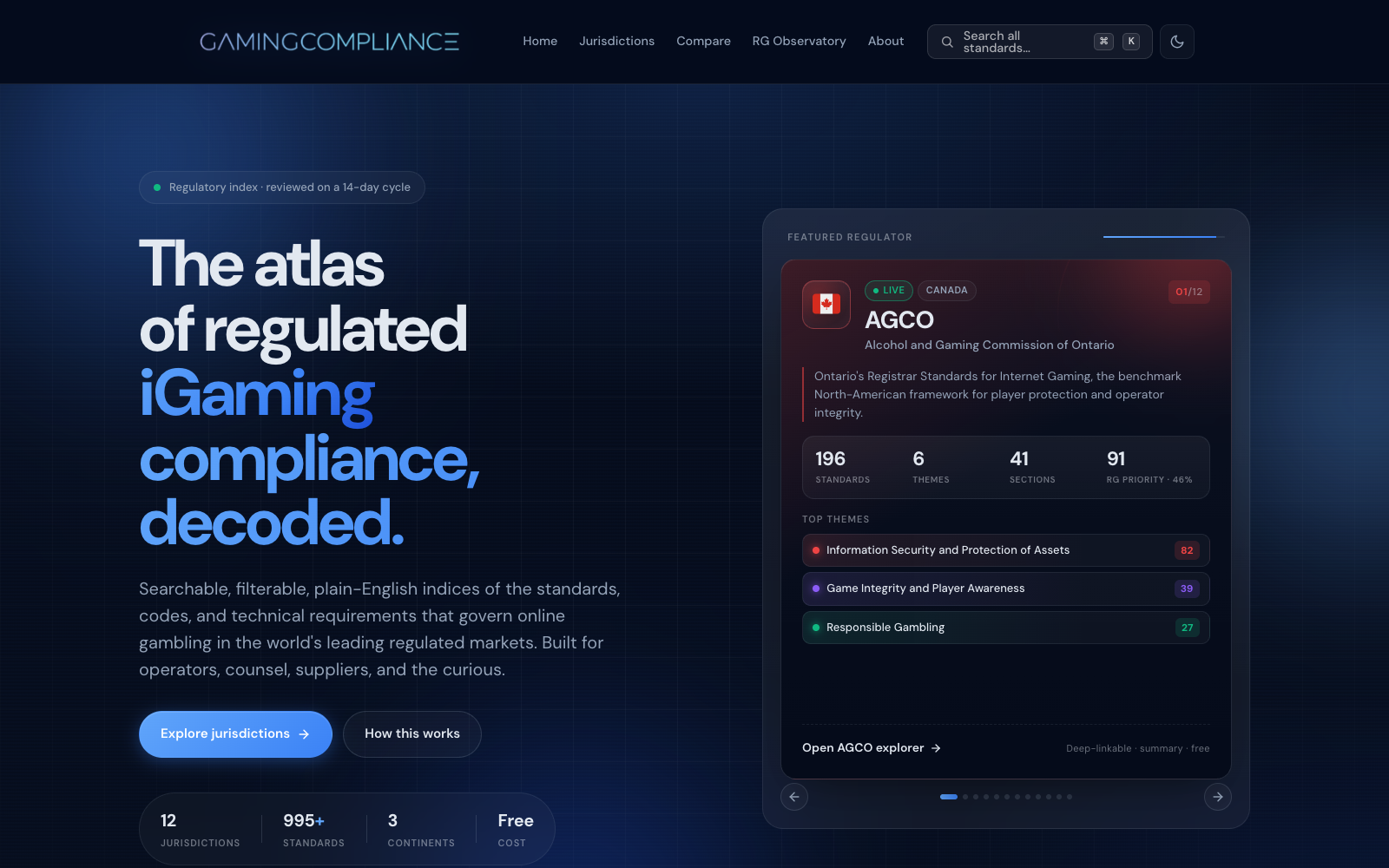
Regulatory intelligence for the global iGaming industry — a structured database of standards, jurisdictional overviews, and practitioner-focused summaries of the rules that actually govern the market.
- standards indexed
- 0
- jurisdictions covered
- 0
- digest subscribers
- 0 k
Problem
Regulatory information in iGaming lives in a frustrating shape.
Primary sources (regulator publications, gazettes, technical standards documents) are authoritative but disorganised — sometimes literally scanned PDFs. Paid compliance databases exist but cost in the five figures annually and are built around the needs of enterprise legal rather than the day-to-day questions a product or marketing team actually asks. Public summaries, when they exist, are often a year stale and written for a jurisdictional audience that already knows the vocabulary.
The gap was a practitioner-facing reference — navigable by jurisdiction, cross-linked by topic, summarised in plain English, and maintainable at a cadence that keeps it honest. Not a legal opinion service and not a CRM for compliance teams. An index that respects the reader's time.
Approach
The content architecture starts with the jurisdictional layer: one page per regulator we cover, each with current licensing regime, key standards, notable enforcement actions, and a summary of what has changed in the last twelve months.
Every claim links to primary source material — the point is to be a navigation layer over authority, not a replacement for it.
On top of that sits the standards database: individual rules extracted from primary regulator output, tagged by topic (AML, responsible gambling, technical certification, advertising, customer protection) and jurisdiction. The database is queryable from any angle — 'show me advertising restrictions in tier-one European markets', 'current RG standards in Ontario', 'everything Malta has published on game certification since 2024' — and every entry is timestamped with the source document.
The summarisation pipeline uses Claude to do structural work (extracting rules from long documents, tagging them consistently, flagging amendments against prior versions) with a human compliance-literate editor reviewing every summary before publication. The weekly digest goes out on Tuesdays and gets quoted by a couple of industry newsletters — an unintended but useful distribution channel.
Outcome
The site has grown into a working reference for a small set of operator compliance teams and a law firm that uses it as a first-pass tool before deeper proprietary research.
Organic acquisition is dominated by long-tail jurisdictional queries ('malta rg self-exclusion timelines', 'ontario iGaming amendment 2025') and industry professionals searching for specific standards.
The business model is affiliate-adjacent: sponsorship of the weekly digest by compliance software vendors, with editorial coverage fully walled off. We turn down paid placement in the database itself as a matter of policy.
Metrics
Lighthouse 95 mobile, 97 desktop.
Database-query pages are cached at the edge which keeps LCP under 1.3s even on the heaviest cross-jurisdictional queries. Approximately 6k monthly sessions — a niche audience with very high intent and meaningful session depth.
420 standards indexed, 22 jurisdictions covered, all jurisdictional overview pages reviewed on a quarterly cycle with changed content flagged for re-review. Digest subscriber list held at CASL-compliant signups only, currently 1,200 industry professionals.
The site's internal link graph.
Every node is a page. Every line is an internal link. Hover to highlight the 1-hop neighbourhood; click to open the page. Crawled weekly.
Field notes
The iGaming regulatory map is genuinely complex — dozens of jurisdictions, different licensing regimes, frequent amendments, and a layer of secondary guidance (AML, RG, technical standards) that sits on top. Operators and their legal teams spend real money on paid databases that are somehow still inconvenient to use.
We built GamingCompliance.io as the resource we’d have wanted in that seat — a navigable, structured index of regulations and standards, cross-linked, summarised for practitioners, and updated on a schedule you can trust.
Have a property that deserves the same care?
We take on two engagements a year. If your problem rhymes with this one, we'd like to hear about it. No pitch decks — just a short conversation to see if the shapes line up.